
How to Search Washington County Traffic Court Records
Traffic cases filed in the Circuit Court are searched through the same free state tool used for other court records. The Oregon Judicial Department runs the Circuit and Tax Record Search, reached from the OJD Records and Calendar Search page. It covers public traffic cases, including active, closed, paid, and dismissed matters where the record is public. A municipal court ticket is searched through that city's court instead, not the state portal.
Before you start, gather the citation or case number if you have it. If not, have the driver's exact name and any dates ready. A citation number is the cleanest way to find one case, while a name search may return more than one match.
- Open the OJD Records and Calendar Search and choose Circuit and Tax Record Search.
- Enter the citation or case number, or type the driver's last name if you do not have the number.
- Select Washington County Circuit Court when a court or location filter is offered.
- Review the matching case for the charge, court date, fine, and disposition.
- Pay, contest, or request a certified copy through the court if a document is not online.
The state tool is described at the OJD Records and Calendar Search page, which links every public search option in one place.
Which Courts Handle Traffic Cases in Washington County
Two kinds of courts hear traffic matters here, and the ticket tells you which one. The Washington County Circuit Court handles most traffic violations and citations filed at the county level. A city municipal court handles city-code violations and certain traffic or parking citations issued within that city. A serious offense such as DUII is a criminal case, so it routes through the Circuit Court's criminal process rather than a simple traffic docket.
The controlling source is always the citation. It names the court, the date to appear, and where to pay. The table below shows the common split, with the Circuit Court address for county cases.
| Court | Traffic Cases Handled | Address |
|---|---|---|
| Washington County Circuit Court | Most traffic violations and citations filed at the county level | 145 NE 2nd Avenue, Hillsboro, OR 97124 |
| City Municipal Courts | City-code violations and some traffic or parking citations within city limits | Varies by city named on the ticket |
| Circuit Court Criminal Process | DUII and other criminal traffic offenses | 145 NE 2nd Avenue, Hillsboro, OR 97124 |
If the ticket reads Washington County Circuit Court, use the state and circuit court tools. If it names a city court, contact that city's court for the case.
Types of Traffic Cases on Record
Traffic cases come in several forms, and each can leave a court record. Most are violations, which are not crimes but still carry fines. Some are more serious. The list below groups the common types a person may find in a Washington County traffic case search.
- Moving violations - speeding, failure to obey a signal, and unsafe driving.
- Non-moving violations - equipment, registration, or insurance issues.
- Parking citations - often handled by a city, not the Circuit Court.
- Commercial vehicle citations - violations tied to a commercial driver license.
- Criminal traffic offenses - DUII and similar charges that route to criminal court.
A violation case usually ends with a paid fine or a dismissal. A criminal traffic case can end with a conviction, probation, or jail, so it follows the criminal track instead.
What Washington County Traffic Court Records Show
A traffic case record gives a clear snapshot of the citation and how it was handled. The exact fields depend on the case and what the law lets the public see. Most records open with the citation or case number, then list the charge, the court date, the fine, and the final outcome. Reading the docket in date order is the easiest way to follow what happened.
| Field | What It Shows |
|---|---|
| Citation Number | The unique identifier for the ticket; use it to find the case fast. |
| Charge / Statute | The violation cited and the law or ordinance it falls under. |
| Court Date | The scheduled hearing or appearance date. |
| Plea / Response | How the driver responded, such as a payment or a not-guilty plea. |
| Fine Amount | The assessed fine and any added court fees. |
| Disposition | The outcome, such as paid, dismissed, or found guilty. |
Some documents are viewable online, while others must be requested from the court. A missing case may be sealed, recently filed, or held in a city court instead.
Searching by Citation Number vs by Name
The two ways to search a traffic case each have a best use. A citation or case number points straight to one record, so it is the cleanest option when you have it. A name search casts a wider net and can return several matches, which is useful when the number is lost but slower to sort. Watch for format errors in citation numbers and for spelling differences in names. The table below lists common search fields.
| Search Field | Type | Required | Notes / Format |
|---|---|---|---|
| Citation / Case Number | Text | No | Best field for a single traffic case. |
| Last Name | Text | No | Use the party or driver name; may return multiple matches. |
| Court | Dropdown | No | Washington County Circuit Court or the city court named on the ticket. |
| Date Range | Date | No | Filing or hearing date to narrow results. |
If a name search returns too many results, add a date range or switch to the citation number to zero in on the right case.
Paying or Contesting a Washington County Traffic Ticket
A ticket gives a deadline to respond, and missing it can add penalties. For a Circuit Court citation, the Oregon Judicial Department offers an online payment option for eligible cases, and the court also accepts payment by the methods listed on the citation. A driver who wants to fight the ticket can enter a not-guilty plea and ask for a hearing instead of paying.
Plea options usually include paying the fine, which works like a no-contest response, or pleading not guilty and going to a hearing. Some matters allow a remote appearance. The steps below outline the usual path.
- Read the citation to confirm the court, the amount, and the response deadline.
- Look up the case through the OJD search to verify the charge and any court date.
- To resolve it, pay the fine through the court's accepted payment method by the deadline.
- To contest it, enter a not-guilty plea and request a hearing before the deadline.
- Attend the hearing, or follow the court's instructions for a remote appearance if offered.
Note: Ignoring a citation can lead to a larger fine, a failure-to-appear entry, or a hold, so respond before the deadline even if you plan to contest it.
Public Access Laws for Traffic Court Records
Oregon's public records framework starts with ORS chapter 192, the Oregon Public Records Law. Court case records also follow court-specific statutes, judicial department policy, and confidentiality rules. Most traffic cases are public, but a request for a copy still goes through the court, and fees may apply for copies, certification, or search time where the law allows. The statutes below shape what you can find and what stays closed.
Key Statutes:
ORS Chapter 192 - the Oregon Public Records Law sets general access rights and exemptions for public bodies.
ORS Chapter 7 - governs court records, clerks, and seals in the circuit courts.
ORS Chapter 21 - sets court filing fees and other court fees.
Court Traffic Records vs State Driver Records
This is the distinction that trips up the most people. A court traffic record is the case file the court keeps for a citation. It shows the charge, court appearances, fines, and the disposition. A state driver record is a separate file kept by the Oregon DMV under ODOT. It shows license status, convictions reported to the DMV, suspensions, and driving history. The two are not the same file, and they come from different offices.
A ticket that is paid or dismissed in court may still have a DMV consequence depending on the law. To fix an error, you correct it where the error lives. The table below compares the two records.
| Record Type | Source | What It Shows | How to Access |
|---|---|---|---|
| Court Traffic Record | Washington County Circuit Court or city court | Citation case activity, court dates, fines, disposition | OJD record search or the court records office |
| State Driver Record | Oregon DMV / ODOT | License status, reported convictions, suspensions, driving history | Oregon DMV driver record request |
Get a court copy from the court and a driving record from the DMV; one office cannot hand you the other office's record.
CDL and Commercial Driver Records
Commercial drivers face stricter rules. A citation tied to a commercial driver license can carry consequences that a regular driver would not see, and CDL reporting rules can be tougher. Some violations that a regular driver might handle through a fine or a course may not be available to a CDL holder. A commercial driver should confirm CDL consequences separately rather than assume a paid ticket clears the matter.
Because CDL rules can affect a livelihood, a commercial driver should check both the court outcome and the driving-record effect before deciding how to respond to a ticket.
DUII Cases
DUII is not a simple traffic violation. In Oregon, driving under the influence of intoxicants is a criminal traffic offense, so it routes through the Circuit Court's criminal process, not a routine traffic docket. That means a different track, with arraignment, possible diversion, and a criminal disposition rather than a paid fine.
For full Washington County DUII and criminal traffic case information, see Washington County arrest records, which covers booking and criminal case lookup.
Deferred and Defensive Driving Options
Some drivers may qualify for an option that changes how a citation ends. A defensive driving course or a similar deferral, where offered, can affect whether a violation sticks on the record. Eligibility, cost, and the effect on the driving record vary by case and by court, so a driver should confirm what is available before counting on it.
The court or the citation explains whether a deferral or course is an option for a given ticket. Not every violation qualifies, and a missed deadline can remove the choice.
Sealing or Setting Aside Traffic Records
Oregon commonly uses the term set aside rather than expungement for clearing eligible records. Most simple traffic violations are not crimes, so they follow different rules than a criminal record. A criminal traffic case, such as DUII, may have set-aside eligibility under ORS 137.225, but the rules are technical and include waiting periods and exclusions.
The set-aside statute is ORS 137.225, which controls many adult record-clearing requests. Eligibility should be checked against the current text before filing.
Washington County Traffic Program
The Circuit Court keeps a local traffic program page that explains how traffic matters are handled in the county. It is the official starting point for county traffic cases, payment options, and what to do with a citation filed in the Circuit Court. The page ties back to the same record search and payment tools used across the court.
The local program is described on the Washington County Circuit Court traffic page.
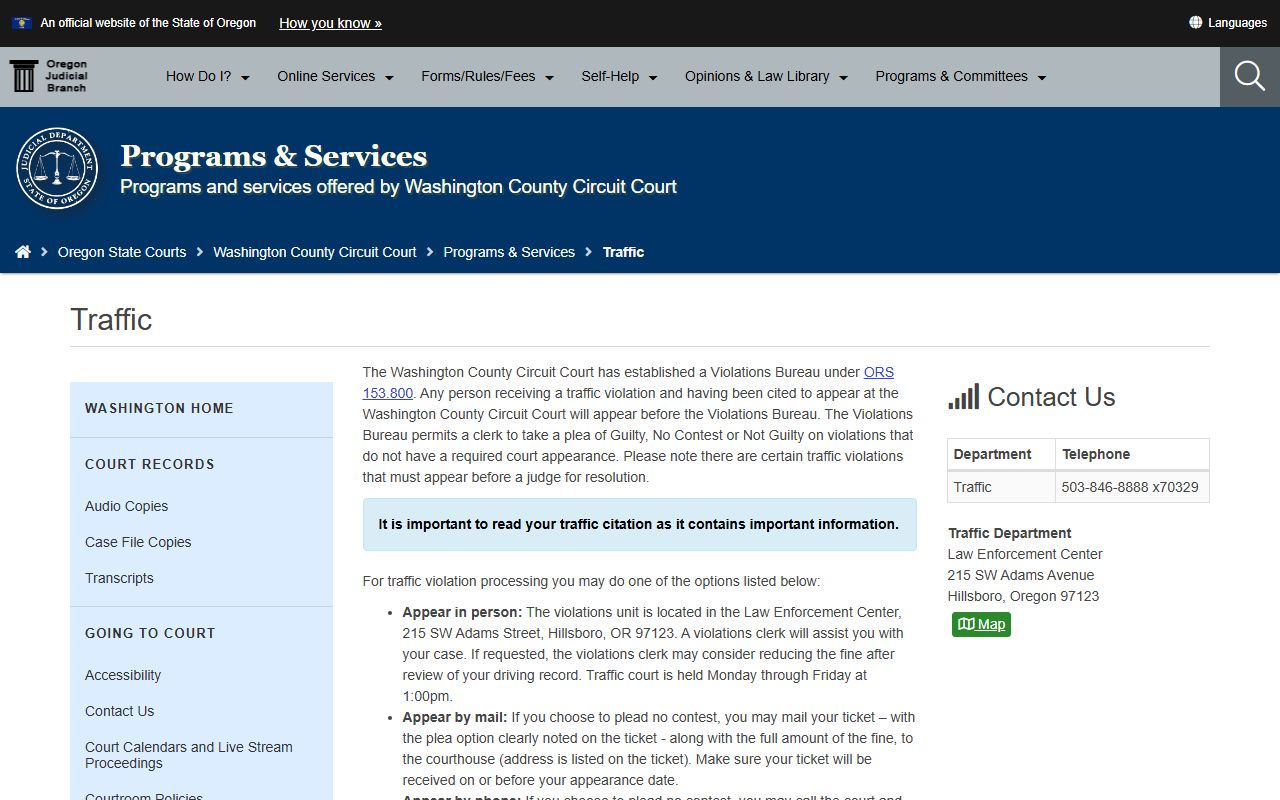
From there, a person can confirm whether the Circuit Court holds the citation and follow the right steps to pay or contest it.
Fees for Traffic Record Copies
Fees depend on the service. Looking up a public traffic case through the free state search costs nothing where the record is public. Copies and certified copies of a court file are requested through the court, and the amount follows the statewide fee schedule. A driving record from the DMV is a separate request with its own fee. Always confirm the current amount before you pay.
| Item | Amount |
|---|---|
| Free basic case search | No cost where the record is public |
| Case-file and certified copies | Set by the OJD fee schedule; request through the court |
| Court fees | Varies by case; see OJD Court Fees |
| State driver record | Separate request and fee through the Oregon DMV |
The court copy and the DMV driving record are billed by different offices, so plan for two separate requests if you need both.